



Can Malaysians Aged 55 and Above Keep RM1 Million in EPF, Earn Dividends and Withdraw Money Whenever They Need It?
Imagine reaching the age of 55 with RM1 million in your Employees Provident Fund (EPF), also known as Kumpulan Wang Simpanan Pekerja (KWSP). Would you withdraw the entire amount and transfer it into a bank fixed deposit (FD), or would you prefer to leave the money inside EPF, continue earning annual dividends and withdraw only when you need additional cash?
For many Malaysians approaching retirement, this is an important financial decision. After spending decades working and contributing towards their retirement savings, the last thing they want is to make a rushed decision that could affect their financial security during their golden years.
Interestingly, Malaysians aged 55 and above have greater flexibility when managing their EPF savings. They do not necessarily have to withdraw everything immediately after reaching this milestone. Eligible savings can remain in EPF, continue earning annual dividends and be withdrawn according to their financial requirements.
But is keeping RM1 million in EPF really worthwhile? How much could the savings potentially earn, and can retirees access their money whenever they need it?
Let’s explore the important details and understand the difference between retaining existing EPF savings and attempting to transfer an additional RM1 million into the retirement fund.
1. Why Keeping RM1 Million in EPF After Age 55 Could Be Worth Considering
One of the main reasons Malaysians continue to consider EPF as a retirement savings option is its historical dividend performance.
Unlike conventional bank fixed deposits, which generally offer an agreed interest rate for a particular placement period, EPF declares dividends annually according to its investment performance and applicable policies.
Looking at its recently published dividend history, EPF has delivered the following returns:
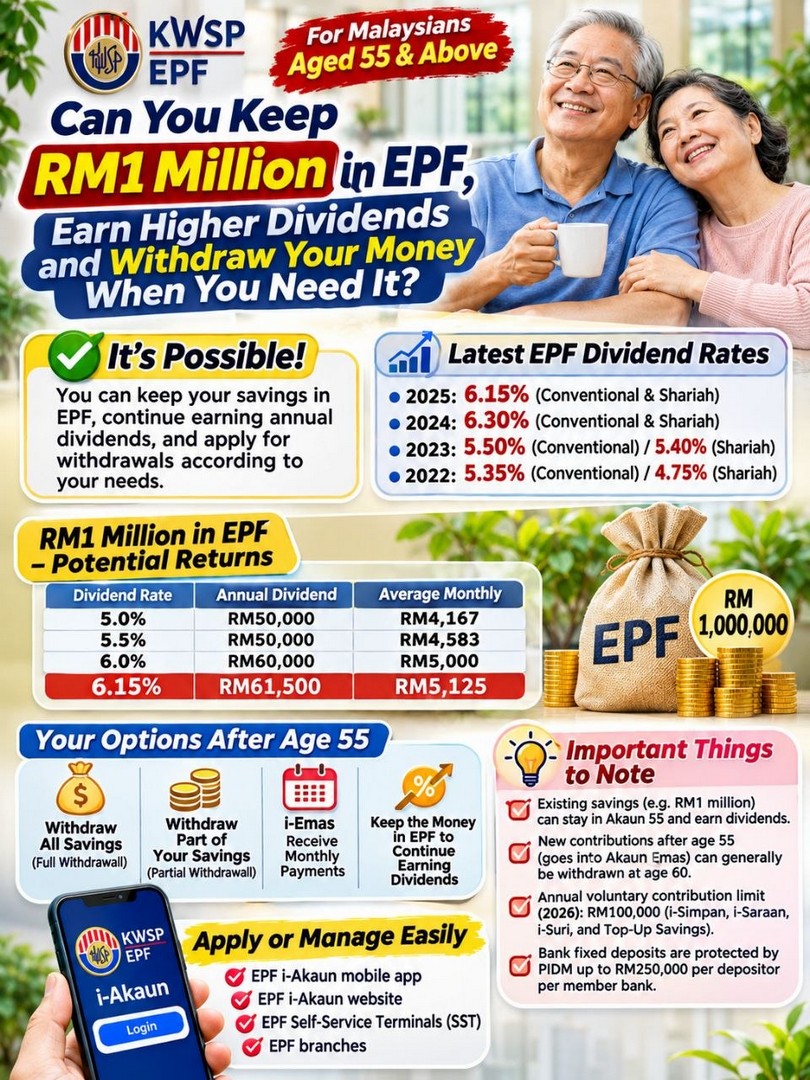
- 2025: 6.15% for Conventional and Shariah Savings.
- 2024: 6.30% for Conventional and Shariah Savings.
- 2023: 5.50% for Conventional Savings and 5.40% for Shariah Savings.
- 2022: 5.35% for Conventional Savings and 4.75% for Shariah Savings.
The latest published dividend rate in the information available for this article was announced on 28 February 2026, covering the 2025 financial year. Both Conventional and Shariah Savings received 6.15%.
So, what could this mean for someone who already has RM1 million in EPF?
Let’s look at some simple calculations to understand the potential returns.
Illustrative annual dividends for RM1,000,000 in EPF:
- At 5%: RM50,000 annually.
- At 5.5%: RM55,000 annually.
- At 6%: RM60,000 annually.
- At 6.15%: RM61,500 annually.
For example, if RM1 million remained in EPF and earned a dividend of 6.15%, the calculation would look like this:
- Initial savings: RM1,000,000.
- Illustrative annual dividend: RM61,500.
- Total savings after the dividend: RM1,061,500.
That works out to an average equivalent of RM5,125 per month in dividend earnings.
Imagine having that amount added to your retirement savings without needing to withdraw your original RM1 million. It certainly makes leaving some money inside EPF an option worth examining.
However, there is an important point to remember. The 6.15% figure is based on the 2025 financial year and is used here purely for illustration. EPF dividends are not guaranteed, and the 2026 dividend rate had not been announced as at 13 November 2026.
Actual dividend earnings can change from year to year depending on investment performance and EPF’s dividend declaration. Members should avoid treating historical returns as a guaranteed future income.
For the official dividend announcements, Malaysians can refer to the EPF website:
https://www.kwsp.gov.my/en/others/resource-centre/dividend
2. Will Your EPF Savings Continue Earning Dividends After You Turn 55?
Yes, reaching 55 does not automatically mean your EPF savings stop earning dividends.
This is an important detail for Malaysians who are approaching retirement but do not immediately need access to all their accumulated savings.
Under EPF’s account structure, eligible savings in Akaun Persaraan, Akaun Sejahtera and Akaun Fleksibel are consolidated into Akaun 55 when a member reaches the age of 55.
Once the savings have been consolidated, members have several options for managing their retirement funds, subject to the applicable EPF withdrawal conditions.
These include:
- Full withdrawal: Withdraw the available savings in one lump sum if the member wants access to the entire eligible balance.
- Partial withdrawal: Take out only the amount required while leaving the remaining savings in EPF.
- Retain the savings: Leave the money in Akaun 55 so the remaining eligible balance can continue earning annual dividends.
- Monthly retirement payments: Explore i-Emas, EPF’s monthly payment facility for eligible members.
- A combination of withdrawals and monthly payments: Arrange access to retirement savings according to personal financial requirements and the applicable programme conditions.
This flexibility can be particularly useful for retirees who already have other sources of income, such as rental earnings, a pension, savings or support from their family.
For example, someone with RM1 million in EPF may not need to withdraw the entire amount immediately after turning 55. Instead, they could retain a substantial portion in the fund and withdraw smaller amounts to cover living expenses, medical bills, household commitments or unexpected emergencies.
The advantage is that the remaining eligible savings can continue participating in EPF’s annual dividend distribution.
Of course, members should understand that dividends are calculated according to EPF’s applicable rules and the balance maintained during the relevant period. Withdrawals can therefore affect the amount of savings available to earn future dividends.
For retirees who value flexibility, this arrangement offers another way to approach retirement without feeling pressured to empty their EPF account as soon as they reach 55.
3. Keeping Existing RM1 Million Is Different From Transferring Another RM1 Million Into EPF
There is one important distinction that Malaysians should understand before making any major financial decision.
Keeping RM1 million that has already accumulated in EPF is not the same as transferring another RM1 million from a personal bank account into EPF after turning 55.
The existing retirement savings are already part of the member’s EPF balance and can be managed under the applicable age-55 withdrawal arrangements.
However, additional contributions are subject to EPF’s contribution rules, eligibility requirements and applicable limits. Members should not assume that they can simply transfer an unlimited amount of personal savings into EPF just because they have reached 55.
Anyone considering a substantial voluntary contribution should first check the latest requirements directly with EPF. They should also consider whether the money might be needed for emergencies, healthcare, daily expenses or other financial commitments.
The key is to distinguish between retaining retirement savings and making new contributions. They are two different financial decisions and should be evaluated separately.
4. Why Retirees Should Think Carefully Before Withdrawing Everything
Having RM1 million available at age 55 is a significant achievement, but managing that money throughout retirement requires careful planning.
Withdrawing everything at once may provide immediate financial freedom, but it also means the money will no longer remain in EPF. Once transferred into a bank account or another investment, the savings will be subject to the returns, risks and conditions of that particular financial product.
On the other hand, keeping some money in EPF may allow eligible savings to continue earning annual dividends.
There is no single answer that suits every retiree. Someone with substantial medical expenses, outstanding loans or plans to purchase a property may have different priorities from someone who already owns a fully paid home and has other sources of income.
A sensible approach is to calculate expected monthly expenses, identify emergency savings requirements and decide how much money should remain accessible.
Retirement planning is not simply about earning the highest possible return. It is also about having enough money available when it matters most.
5. Is EPF Better Than a Bank Fixed Deposit After Retirement?
This is another common question among Malaysians who have accumulated substantial retirement savings.
Both EPF and bank fixed deposits have their own advantages. The better option depends on how retirees want to manage their money, their financial commitments and their willingness to accept different levels of investment risk.
A bank fixed deposit may offer a predetermined interest rate for an agreed period, depending on the product and its terms. It can be useful for people who prefer knowing the interest they will receive over the placement period.
EPF, meanwhile, declares annual dividends based on investment performance. Its historical dividend rates may look attractive compared with certain fixed deposit offers, but the returns are not guaranteed.
Here are a few considerations before making a decision:
For those who prefer flexibility: Keeping eligible savings in EPF allows members aged 55 and above to make withdrawals under the applicable arrangements rather than taking everything out immediately.
For those who want predictable returns: Fixed deposits may be worth considering, especially when promotional interest rates are available. However, members should compare the placement period, early withdrawal conditions and deposit protection arrangements.
For those who want to spread their savings: Retirees may consider keeping part of their money in EPF while placing another portion in suitable bank savings or fixed deposit products.
The most important thing is not to put all retirement savings into one financial arrangement without considering personal circumstances.
6. What Should Malaysians Do Before Making Their Retirement Decision?
Before deciding whether to retain RM1 million in EPF or withdraw part of it, members should take some time to review their retirement plans.
Start by checking the available EPF balance and understanding how much is eligible for withdrawal. Next, calculate monthly expenses, including food, utilities, transportation, insurance, medical costs and family commitments.
It is also sensible to maintain accessible emergency savings. Retirees should not have to withdraw long-term savings unnecessarily whenever an unexpected expense arises.
For those considering i-Emas monthly retirement payments, it is worth checking the latest eligibility requirements, payment arrangements and application procedures directly with EPF.
Most importantly, anyone considering transferring a large amount of additional money into EPF should confirm the applicable contribution limits and conditions before proceeding.
Official information is available through the EPF Malaysia website, where members can also explore the latest withdrawal arrangements and retirement-related services.
Final Thoughts: Should You Leave RM1 Million in EPF After Turning 55?
For Malaysians fortunate enough to have RM1 million in EPF savings by the age of 55, there is no automatic requirement to withdraw everything immediately.
Leaving eligible savings inside EPF can be an option worth considering, particularly for retirees who do not need the entire amount straight away. The remaining balance may continue earning annual dividends, while partial withdrawals can provide access to money when necessary.
Using the 2025 dividend rate of 6.15% as an illustration, RM1 million could generate RM61,500 in dividends over a year. That is equivalent to an average of RM5,125 per month, although actual dividends will depend on future declarations and the applicable calculation.
The biggest attraction is the flexibility to plan withdrawals instead of making a one-time decision to remove all retirement savings.
However, remember that keeping existing savings in EPF and transferring an additional RM1 million into the fund are two different matters. Contribution rules, withdrawal conditions and personal financial needs must all be considered.
Ultimately, retirement should be about enjoying greater financial freedom, not constantly worrying about whether there will be enough money for the next month.
Before making a decision, Malaysians should review the latest EPF guidelines, compare available financial options and seek professional financial advice where necessary.
A well-planned retirement strategy can help make those golden years more comfortable, secure and enjoyable.
Promotional/Event Details
-
Date: 13 November 2026 onwards (Retirement and EPF information guide; not a limited-time promotion)
-
Time: Not applicable. EPF services are subject to official operating hours and online service availability.
-
Venue: Employees Provident Fund (EPF/KWSP) Malaysia – Nationwide and online.
-
Official Website: https://www.kwsp.gov.my/en
-
Dividend Reference: EPF Dividend Information

EverydayOnSales help brands connect with our community, the largest warehouse sales consumers database in Malaysia. Advertise with EverydayOnSales Malaysia.